


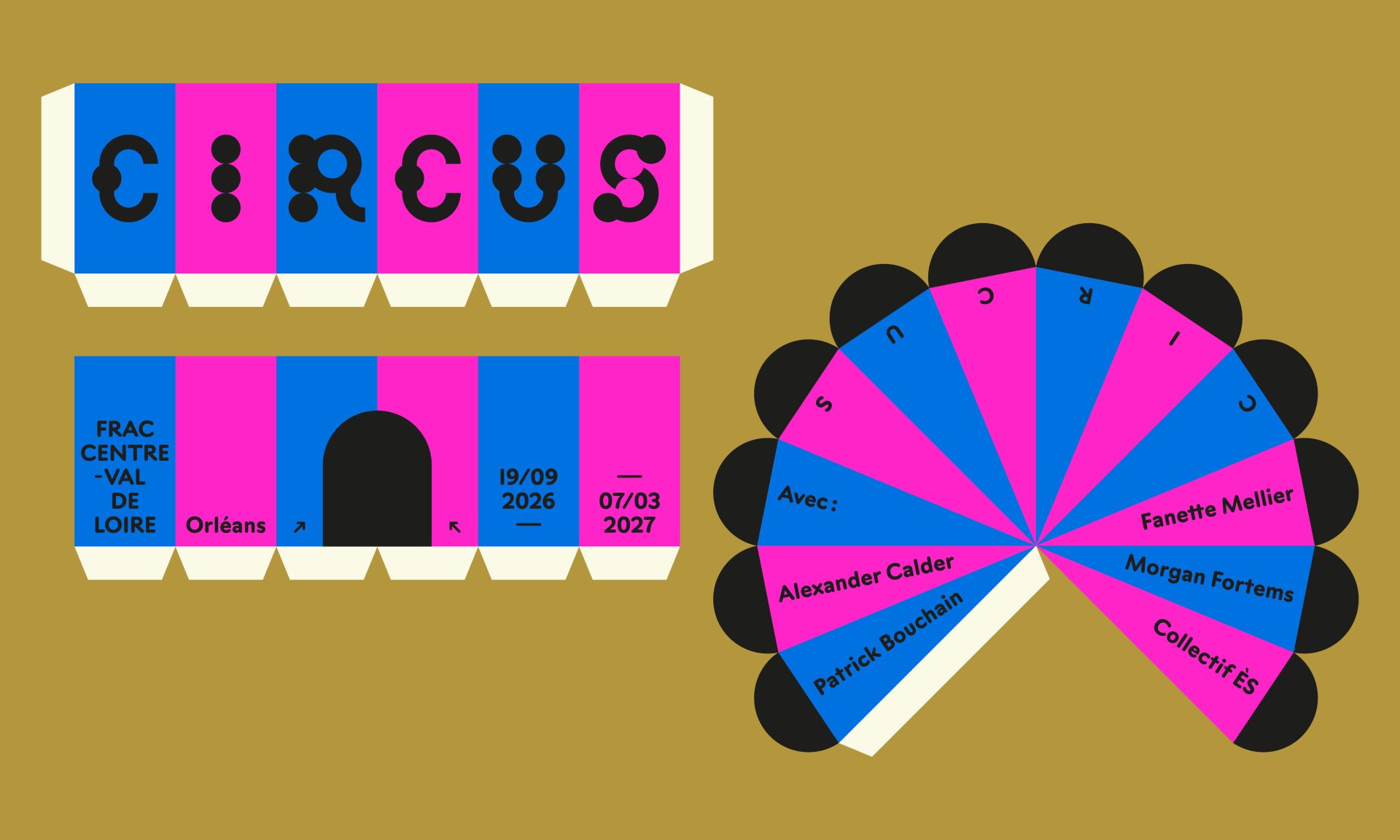
CIRCUS
Alexander Calder
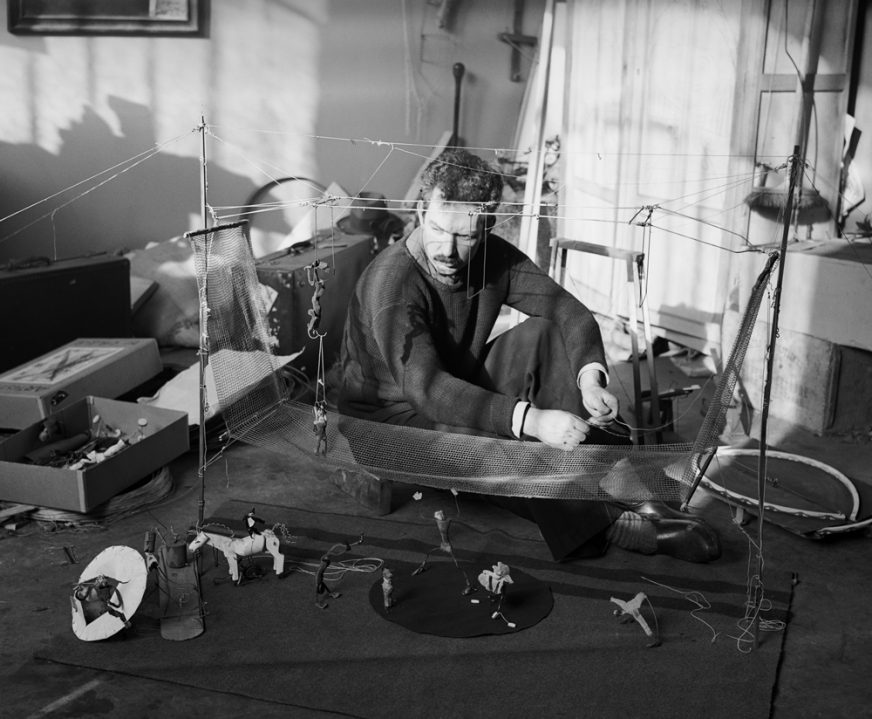 André Kertész, Alexander Calder dans son atelier parisien lors d’une représentation du Cirque, 1929 © Archives André Kertész, ministère de la Culture (France), Médiathèque du patrimoine et de la photographie (MPP) © Calder Foundation, New York / ADAGP, Paris, 2026
Wire, corks, scraps of fabric and a few pieces of string. In Alexander Calder’s hands, these everyday materials became a world in motion. Acrobats, clowns, animal trainers and animals were brought to life in his miniature circus, which fit into just a few suitcases and could be set up anywhere. All it took was an improvised circus ring, a few benches and an audience.
Calder began designing the Cirque Calder in 1926 in his modest Parisian studio; the result was far more than a collection of articulated figurines. It was a seminal work that occupied a very special place in his career as a sculptor. Initially devised as a form of entertainment, the Circus became a laboratory of forms where the principles that would underpin all his work took shape: movement, balance, tension, the interplay with gravity, and the animation of sculpture. This experimentation went on to influence the development of his future Mobiles.
The Cirque Calder is also regarded as one of the earliest examples of performance art. Featuring around twenty acts and more than 200 characters and props, the artwork, conceived as a show, only comes fully to life when it is set in motion. The performances were a resounding success on both sides of the Atlantic; the Circus quickly became Calder’s calling card in the Parisian art scene of the interwar period.
Presenting the Cirque Calder in the context of Patrick Bouchain’s work brings its architecture to the forefront. An architecture beyond the monument, made of modest materials, lightweight structures and gestures. Transported in a few suitcases, assembled and dismantled as and when performances required, the Circus prioritised an economy of means, reuse and the collective experience over permanence. This conception of space resonates with the circus tents designed by Bouchain, where architecture is defined above all by the uses it enables.
Patrick Bouchain
The Circus exhibition, drawn from the archives donated by Patrick Bouchain to the Frac Centre-Val de Loire in 2016, brings together twelve projects designed for the world of the circus or which borrow certain ways of constructing, creating and inhabiting spaces from that world.
From the Théâtre Zingaro to the Channel, the Académie Fratellini and the Mobile Centre Pompidou, these canvas, wood and metal tents were designed to host the circus and performing arts, but some also housed masterpieces of art history, or even schoolchildren from a city experiencing rapid population growth.
Whether the commission came from artists, as in the case of the Volière Dromesko or the Théâtre du Centaure, from a local council, as with the École Foraine in Saint-Jacques-de-la-Lande, from cultural institutions or even from the local residents, with Le Plus Petit Cirque du Monde, it would always respond to a unique context and situation, embodied through a wide range of architectural forms and layouts.
“Who are we building for?” – rather than “What are we building?” – is the question that guided each of the projects presented here.
For nearly forty years, Patrick Bouchain continually pushed the boundaries of his discipline. He would focus on the ways in which places are used and appropriated rather than on their form, and created situations in which craftspeople, artists, students, neighbours and clients worked together to create constantly evolving spaces capable of accommodating both people and animals. These spaces also share a common focus on what already exists, on mobility, on the temporary, which sometimes becomes permanent, on economy of means, and on craftsmanship.
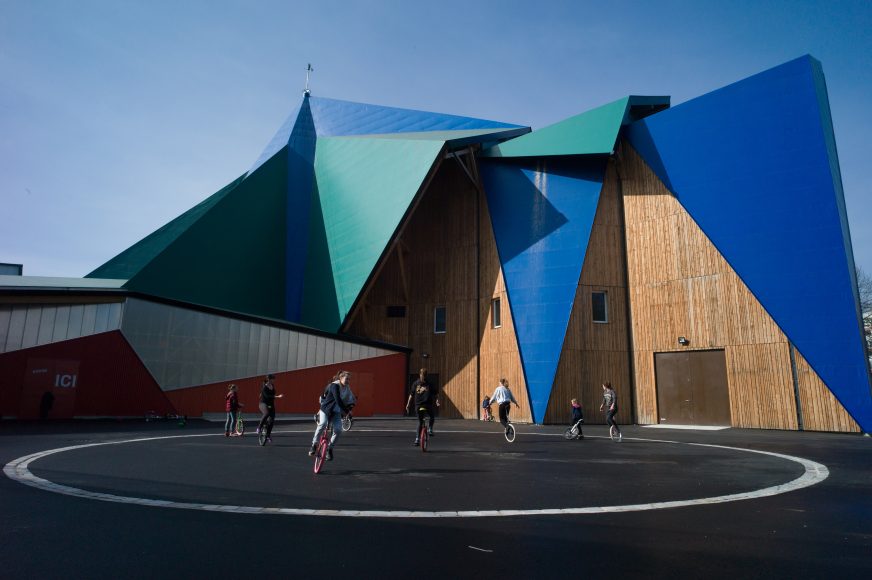 Patrick Bouchain – Agence Construire, Le Plus Petit Cirque du Monde, Bagneux, 2012. Courtesy PPCM
Alongside the models, drawings and photographs on display in the exhibition, the archives reveal not only the structures, whether completed or not, but also the discussions, negotiations, collaborations and even the celebrations that made up the design and construction phase of each project.
Just like in the circus, nothing is done alone, and the exhibition also bears witness to the history of an approach that Bouchain passed on to the young architects with whom he collaborated, notably at the agency Construire, and who today reinterpret, question and reinvent it in their own projects.
For Patrick Bouchain, the circus became a method for conceptualising and practising a form of architecture that he described as “fairground”. One that is vibrant, shared and in constant motion.
Fanette Mellier
Fanette Mellier is a French graphic designer who graduated from the École des Arts Décoratifs de Strasbourg in 2000. She has developed a practice at the intersection between graphic design and artistic experimentation, through books, posters, objects, installations and projects in the public space. Her research mainly focuses on typography, colour, printing techniques and the relationship between signs and their environment. A Villa Medici resident in 2012-2013, she undertakes personal projects and collaborates with writers, musicians and set designers.
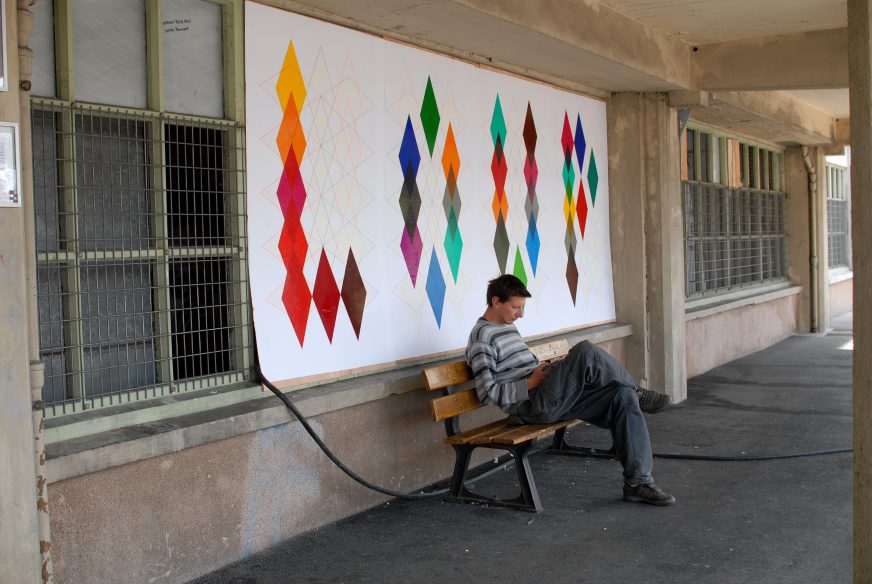
For the CIRCUS project, presented on the walls of the Frac, Fanette Mellier returns to her installation Circus, created in 2008 for the Chaumont International Biennial of Graphic Design. Using a short text by Laure Limongi, she created a journey of reading throughout the city as part of the Biennial, with each word spread out on posters hung up in the public space. Composed of a typographic framework and colourful geometric forms, the letters – one per poster – are revealed as the viewer moves further away, thus entering into dialogue with the urban landscape and architecture.
At Frac Centre-Val de Loire, Circus unfolds in areas of traffic, where signs and letters orient visitors between the various galleries in the exhibition, while progressively drawing them into the joyful world of the circus.
Le Collectif ÈS
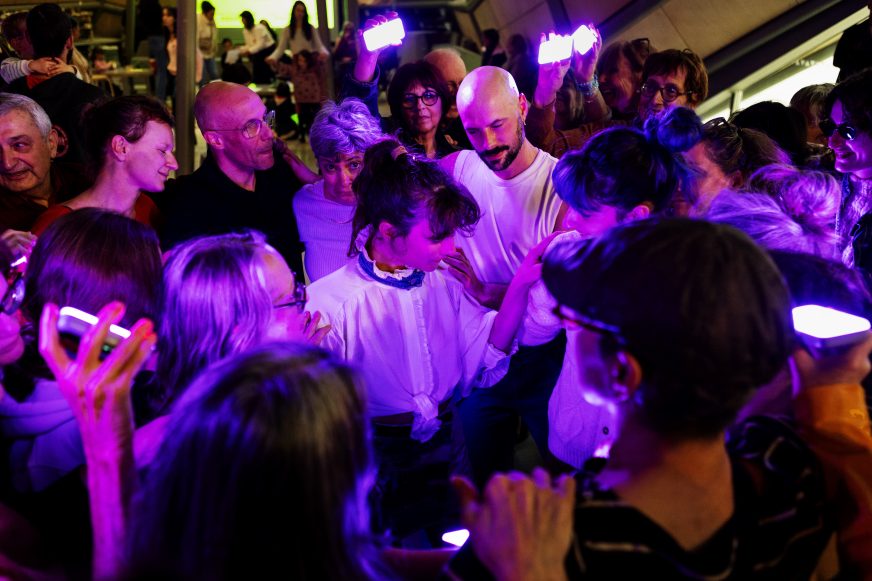
Collectif ÈS, led by Sidonie Duret, Jérémy Martinez and Émilie Szikora, took the helm of the Centre Chorégraphique National d’Orléans in 2025, developing an artistic and cultural project rooted in the collective.
ÈS is a preposition that means “in the field of”. It is always followed by a plural form and thus implies multiplicity, reflecting what the trio seeks in the idea of the collective.
The creative process is seen as a shared manufactory to propose objects that come from us, cultivating joy and bringing together the history of contemporary dance with each of our personal stories.
For the CIRCUS exhibition, their aim is to develop a project that reflects their convictions: joyful, physical, community-minded and citizen-oriented. Les Turbulences is an ideal space to experience these precious concepts of otherness, collective momentum and coming together. The trio is working with 12 to 13-year-old students from Alice & Jean Pelletier Middle School, as part of the Les Blossières Cultural District Twinning initiative, for the project J’peux pas, j’ai Circus ! (I Can’t, I’m Joining the Circus!). Drawing on the world of the exhibition, the youths will compose their own choreographic score. With the artists’ guidance, they become true “dance masters”. At the public performance, the troop will make the Frac a place to come together, dance and celebrate!
Morgan Fortems
After studying architecture, ecology and multimedia, Morgan Fortems has gone on to work mainly as an exhibition designer, graphic designer and artistic director. Alongside his professional and artistic activities, he is constantly engaged in collaborative projects that support dissemination and contemporary creation. He has taken part in reflection groups, organised many events and handles the daily coordination of My Monkey, a gallery and shared creative space that he founded in 2003. He also runs a research workshop called Réparer La Ville (Repairing the City) at the École Nationale Supérieure d’Art et de Design de Nancy.
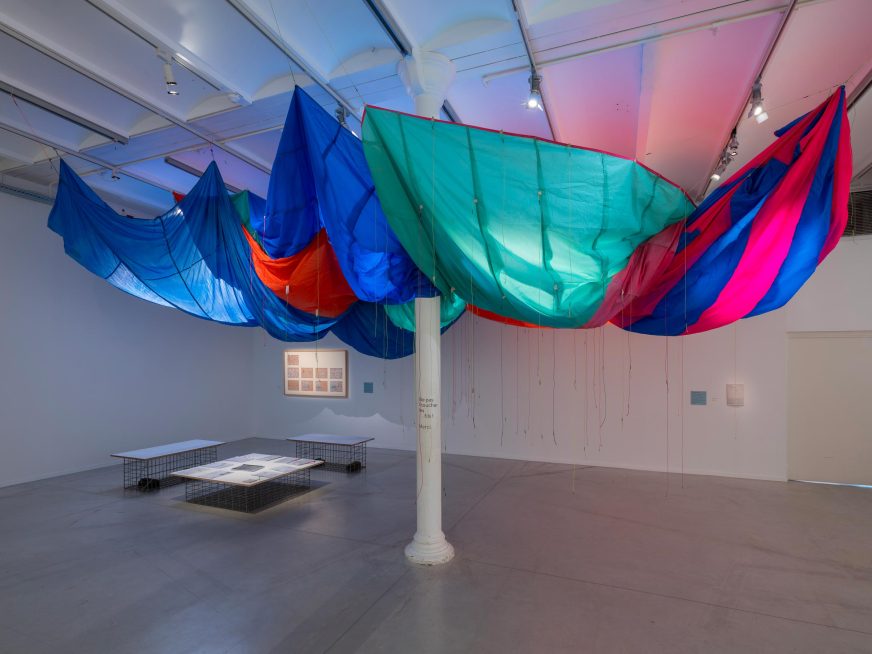
In 2025, at Frac Centre-Val de Loire, Morgan Fortems accepted the challenge of creating a 100% reused set, for the exhibition titled Des villes pour vivre, Yona Friedman (Towns for the Living, Yona Friedman). This time, for the CIRCUS exhibition, he has drawn from all the stocks of materials in storage, along with the display elements at his disposal, to present the models, drawings and archives of circus projects designed by Patrick Bouchain. The bases, made from untreated timber battens, are the only pieces to be produced new for the exhibition: designed with an eco-responsible approach, they themselves will be reused after the exhibition. Once again, the exhibition design resonates with the values and methods that guided the projects on display.