
NOTICE
Yona Friedman


Yona Friedman
Born in 1923 in Budapest (Hungary).
Lives and works in Paris (France)
 
Yona Friedman studied at the Technical University in Budapest, before continuing his training from 1945 to 1948 at the Technion in Haifa, Israel, where he worked as an architect until 1957. In 1953-54, he met Konrad Wachsmann, whose studies on prefabrication techniques and three-dimensional structures had a considerable influence on him. In 1954, together with some inhabitants of Haifa, Friedman embarked upon an initial experiment involving housing designed by the occupant, but this project never reached completion. In 1956, at the 10th International Congress of Modern Architecture (ICMA) in Dubrovnik, modernism was called into question by his universalist approach and his belief in progress. At the Congress, when people were taking "mobile architecture"to mean the mobility of the dwelling" the "mobile home"for example" Friedman exhibited for the first time the principles of an architecture encompassing the on-going changes required to provide "social mobility", based on dwellings and town-planning provisions that could be composed and re-composed, depending on the intentions of the occupants and residents. The Dubrovnik debate gave rise to several think-tanks within the International Congresses, as well as beyond them. Thus it was that in December 1958, Friedman founded the Mobile Architecture Study Group (MASG) which, up until 1962, would focus on the adaptation of architecture to the changes occurring in modern life. He was joined by Kühne, Otto, Ruhnau, Hansen, Frieden and, after 1960, Schulze-Fielitz and Maymont.

The principles of the "spatial city", in other words a spanning three-dimensional structure, were drawn up by Friedman in 1958, the year when he imagined "Spatial Tunis", "Spatial Paris" and, in 1959, Monegasque Venice. This research inspired the visionary "Archigram" projects in London in about 1963, as well as the approach of the Japanese Metabolists in the 1960-1970 period. In 1960, Kurokawa had become acquainted with Friedman's research work in France, as well as the studies carried out by Paul Maymont and Ionel Schein. He accordingly proposed helicoidal or spiral-shaped spatial cities, just as Kenzo Tange was undertaking research that was very similar to Friedman's, as was shown in 1967 by the Yamanaschi Communication Center, and Arata Isozaki was busy with his projects involving "growing" spatial architecture. From 1960 onward, Friedman's projects were published in Japan.

In 1958 or thereabouts, Friedman formulated his "African Propositions" which consisted in combining techniques for local constructions with a modern infrastructure. In 1963, he developed a line of thought about bridge-cities, and planned a bridge over the English Channel. In the mid-1970s, he was still concerned with the design of housing for developing countries, in Asia, Africa and South America. In 1975 (for the Dubonnet factory), and then in 1979 (for the Bergson lycée in Angers, France), he undertook a fully-fledged experiment in self-planning, that is to say, an experiment involving the design of a building - in this instance a public one - by its future users. To do this, he transformed his book Pour l'architecture scientifique into a "scientific method" for architectural design (the topic of his university courses) in "comic strips", so that non-professional people could understand and apply this method. In 1987, he completed the "Museum of Simple Technology" in Madras, India, which implements principles of self-construction based on local materials such as bamboo.

Mobile architecture
In 1958, Yona Friedman published his first manifesto : "Mobile architecture". The mobility in question is not the mobility of the building, but the mobility of the user, who is given a new freedom. "The building is mobile in so much as any sort of use whatsoever by the user or a group must be possible and realisable", Friedman explained. Mobile architecture is thus the "dwelling decided on by the occupant" by way of "infrastructures that are neither determined nor determining". Mobile architecture thus meant an architecture that was available for a "mobile society". To deal with this mobile society, the classical architect had invented "the Average Man", and the projects of architects in the 1950s were undertaken, according to Friedman, to meet the needs of this make-believe entity, and not to attempt to meet the needs of the actual user. The teaching of architecture was largely responsible for the under-estimation by the architect of the role of the user. But this teaching did not embrace any real theory of architecture. Friedman also proposed teaching manuals for the fundaments of architecture for the public. "If a theory is well constructed and spread abroad, it has the advantage of no longer being the property of specialists, but of stemming from the public domain. The present-day monopoly of the architect has to do with the fact that there is no real theory, but merely a set of pseudo-theoriesä in other words, observations which only reflect the preferences of their authors". "A theory must be general and valid for anybody". "Everyone has their hypotheses. The general theory that I am trying to propound underpins all individual hypotheses". The spatial city, which is a materialization of this theory, thus makes it possible for everyone to develop his or her own hypothesis. This is why, in the mobile city, buildings should :
1) touch the ground over a minimum area
2) be capable of being dismantled and moved
3) and be alterable as required by the individual occupant"(Y.F.).
These criteria for the mobile city are decisive for the model of the spatial city.

The Spatial City
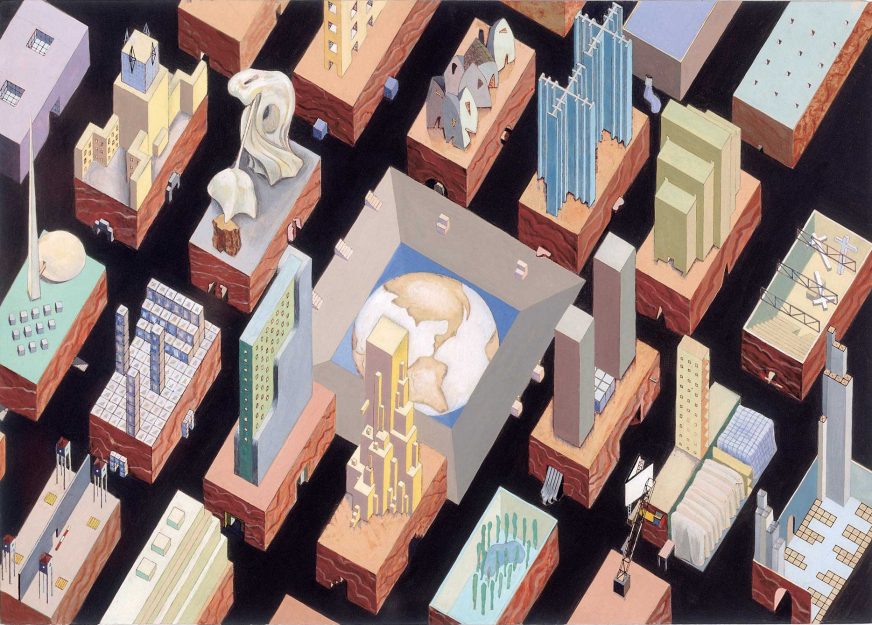
The Spatial City is the most significant application of "mobile architecture". It is a spatial structure raised up on piles which contains inhabited volumes, fitted inside some of the "voids", alternating with other unused volumes. This structure may span certain unavailable sites, and areas where building is not possible or permitted (expanses of water, marshland), or areas that have already been built upon (an existing city). It may also be used above farmland, and introduce a kind of merger between countryside and city. This city built on piles is a three-dimensional structure designed on the basis of trihedral elements which operate as "neighbourhoods"where dwellings are freely distributed.

´ This spanning technique which includes container structures ushers in a new development in town-planning ... the aspect of the three-dimensional city. What is involved here is an increase in the original area of the city with the help of raised plans"(Y.F.). The tiering of the spatial city on several independent levels, one on top of the other, determines "spatial town-planning" both from the functional and from the aesthetic viewpoint. The lower level may be earmarked for public life and for premises designed for community services as well as pedestrian areas. The piles contain the vertical means of transport (lifts, staircases). The superposition of levels should make it possible to build a whole industrial city, or a residential or commercial city, on the same site. In this way, the Spatial City forms what Yona Friedman would call an "artificial topography", a grid suspended in space which outlines a new cartography of the terrain with the help of a continuous and indeterminate homogeneous network (this modular grid would authorize the limitless growth of the city).

The "voids"in this grid are rectangular and habitable modular "voids", with an average area of 25-35 sq.m. Conversely, the form of the volumes included within the grid depends solely on the occupant, and their configuration in the grid is completely free. Only one half of the spatial city would be occupied. The "fillings"which correspond to the dwellings only actually take up 50 % of the three-dimensional lattice, permitting the light to spread freely in the spatial city. "The layout will resemble a kind of grid with regular fixtures (the pillars). Below this grid is the irregular design of the radial buildings, freely meandering in relation to the use for which they are designed". This introduction of elements on a three-dimensional grid with several levels on piles permits a changeable occupancy of the space by means of the convertibility of the forms and their adaptation to multiple uses. "Each volume used is not necessarily an obstacle to transformability, but a point of departure or a terminal station for certain inhabitants". ´"The city, as a mechanism, is thus nothing other than a labyrinth : a configuration of points of departure, and terminal points, separated by obstacles". (Y.F.).

 
M.A.B.
 
© FRAC Centre